

Learning Tools

Curriculum
All math topics


What Are the Power Rules for Variables?
It is very important to know the six rules of powers, or exponentiation. Here, we’ll go through each of them and you’ll see why they work. Rules 1 and 2 are presented in this entry, followed by Rules 3 and 4, about dividing powers, and Rules 5 and 6, about powers of parentheses. At the end, you will find some examples where you’ll have to use several of the rules at the same time.
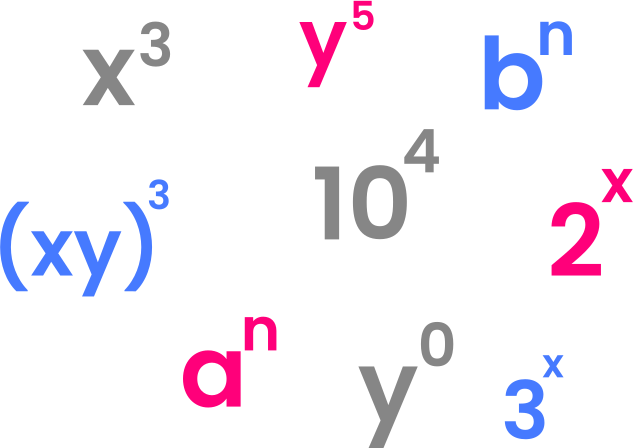
There’s no reason to be afraid of these. As long as you make sure to follow the rules, you’ll always end up in the right place. That’s why one of the first steps you should take is to memorize these six rules! But first, let’s examine what powers look like.
Rule
Powers
The expression is called a power.
is called the base.
is called the exponent.
Rule 1
Rule
To the Power 0
Anything with an exponent of 0 equals 1, as long as ( is undefined).
Example 1
Here are a couple of different examples of 0 being the exponent, showing that the answer is always 1.
Rule 2
Rule
Multiplying Two Powers with the Same Base
Let’s have a look at how this must be true with the help of an example:
and
This means that
This rule is very important to memorize. Here are some more examples:
Example 2
Simplify as much as possible
Simplify as much as possible
Simplify as much as possible
