

Learning Tools

Curriculum
All math topics


How to Calculate Zeros or Roots of a Function
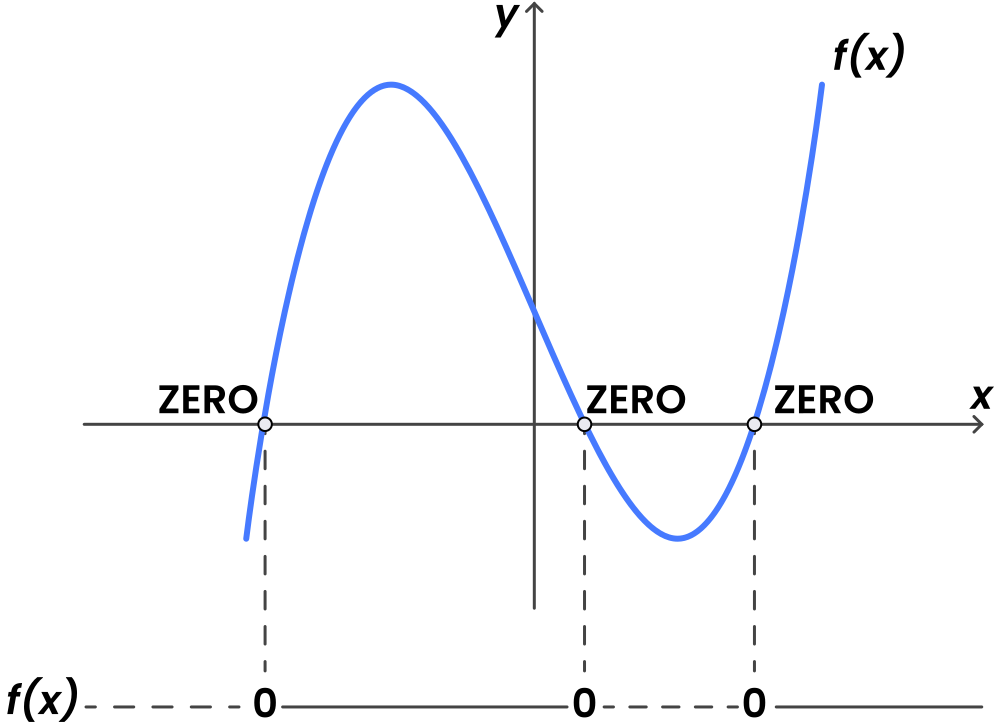
The zeros or roots of a function tell us where a graph intersects the -axis. Since we’re talking about intersection with the -axis, you know that . That means that you can find the zeros by solving the equation .
Rule
The sign chart of tells you when the graph of is above or below the -axis, and where intersects the -axis.
Example 1
Find the zeros of
You find the zeros by solving the equation :
This gives
So the graph meets the -axis at the points i and .
Example 2
Find the zeros of in the interval
Again, you can find the zeros by solving the equation :
The basic equation has the solutions
Solving these for , you get
Since the interval is , you get that . The graph meets the -axis at the points and .
