Learning Tools

Curriculum
All math topics


Examples of Larger Constructions
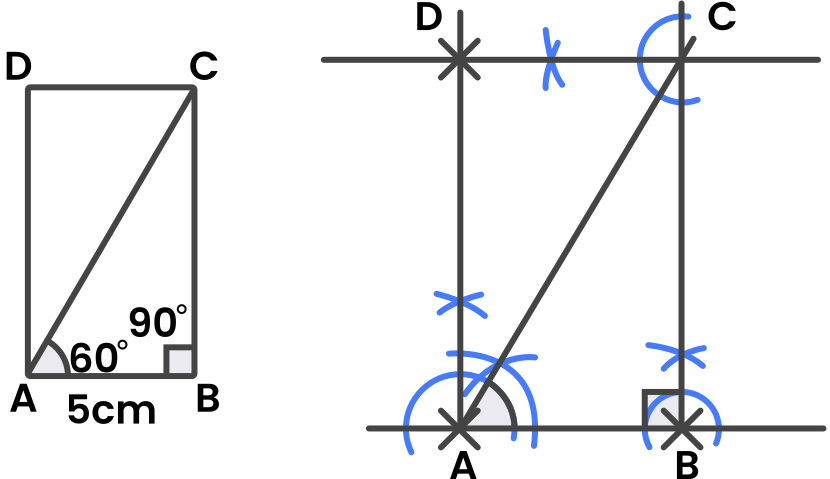
You’re going to construct a triangle and a quadrilateral with the following specifications:
- 1.
- is °, the line is long, and is °. Construct the triangle .
What kind of triangle is this? How large is ?
- 2.
- The area of the triangle in Exercise 1 is half the area of the rectangle .
How long are the sides in the rectangle? How long is the diagonal?
Example 1
Make an auxiliary figure, which is a small figure of what you’re going to construct. Mark the angles, lengths, and any other information.
Begin the construction:
-
Draw a long line.
-
Mark point and measure along the line to point .
-
Construct a ° angle at .
-
Construct a ° angle at .
-
Name the intersection between and , .
-
This is a right triangle.
-
.
Example 2
Continue the construction by constructing the quadrilateral :
-
Construct a normal on the line at .
-
Construct a normal on at . Name the intersection between the two normals . You have now constructed the rectangle .
-
Because the rectangle is made up of two “°-°-°” triangles, the hypotenuse is twice the length of the shortest leg. That means the diagonal is .
-
To find the height of the triangle, you use the Pythagorean theorem:
You’ve found that the sides are and , and the diagonal is .