White H House of Math logo on multicolored square

Learning Tools

Curriculum

Curriculum

Curriculum

Log in

What Is the Law of Cosines?

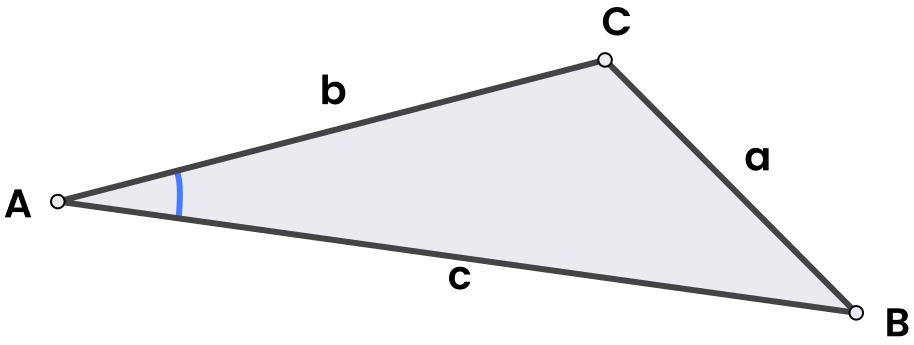
Triangle with the law of cosines

The law of cosines is the general form of the Pythagorean theorem, which means it can be used on any triangle. You can see that when A = 90°, you get − 2bc ⋅ cos ⁡ A = 0, and you’re left with the Pythagorean theorem.

Formula

The Law of Cosines

If b and c are two sides that span an angle ∠A, then

a2 = b2 + c2 − 2bc ⋅ cos ⁡ A (1) cos ⁡ A = b2 + c2 − a2 2bc (2)

Rule

Uses

You can use the law of cosines to

  • Find a side in a triangle when you know the two other sides and one angle in the triangle—Formula (1).

  • Find an angle in a triangle when you know all three sides of the triangle—Formula (2).

Example 1

You have a quadrilateral □ABCD, where AB = 12, AD = 9 and ∠A = 120°. Find the diagonal BD.

The first thing to do is to make an auxiliary figure to help you visualize the problem.
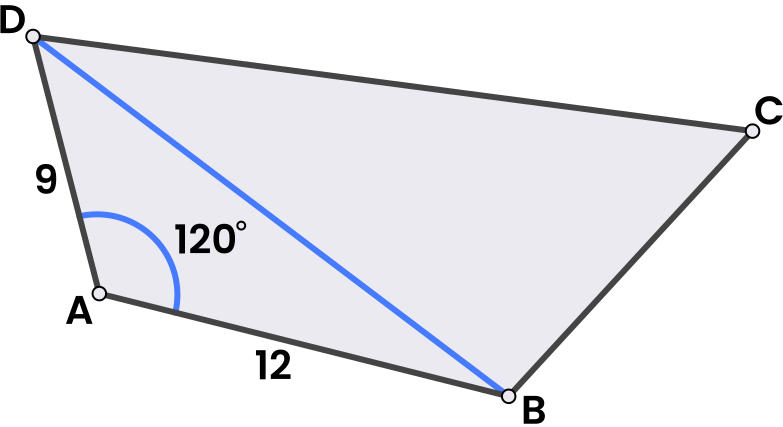
Example of using the law of cosines 1

You can see that this fits with the law of cosines in (1). Insert the numbers to find BD:

BD2 = AB2 + AD2 − 2 ⋅ AB ⋅ AD ⋅ cos ⁡ 120° = 122 + 92 − 2 ⋅ 12 ⋅ 9 ⋅ cos ⁡ 120° = 144 + 81 − 216 ⋅ (−0.5) = 333 BD = 333 ≈ 18.25

Thus BD ≈ 18.25.

Example 2

You have a triangle △ABC, where AB = 7, AC = 5 and BC = 10. Find ∠A.

The first thing to do is to make an auxiliary figure, to help you visualize the problem.
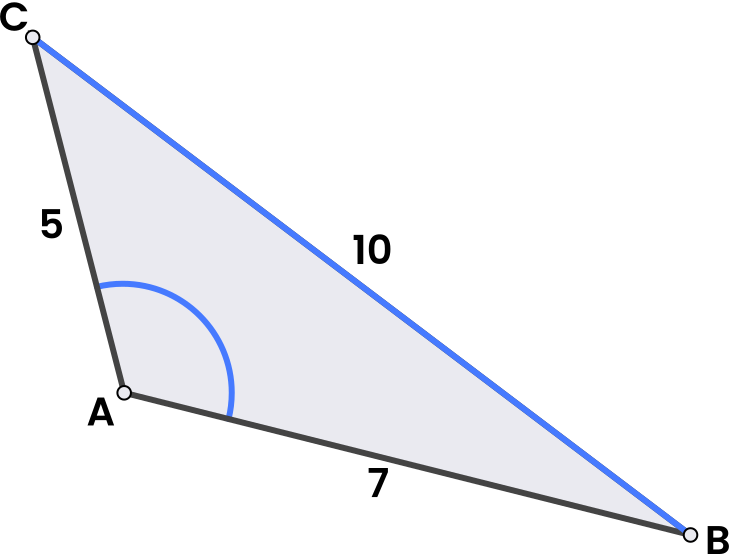
Example of using the law of cosines 2

You can see that this fits with the law of cosines in (2). Insert the numbers to find ∠A.

cos ⁡ A = AB2 + AC2 − BC2 2 ⋅ AB ⋅ AC = 72 + 52 − 102 2 ⋅ 7 ⋅ 5 = 49 + 25 − 100 70 = − 26 70 A = cos ⁡ −1 ( − 13 35 ) ≈ 111.8°

So the angle ∠A is about 111.8°.