White H House of Math logo on multicolored square

Learning Tools

Curriculum

Curriculum

Curriculum

Log in

How to Calculate Area of a Parallelogram with Vectors

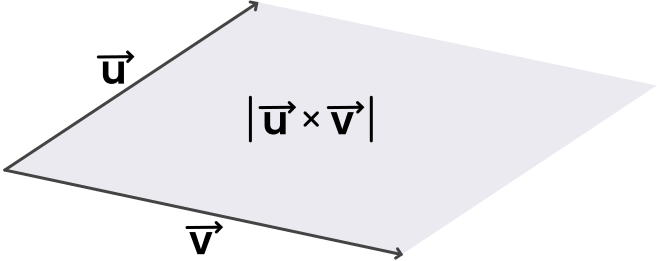
Finding the area of a parallelogram spanned by u→ and v→ is the same as calculating the length of the u→ ×v→-vector.

Two vectors and the area of the parallelogram spanned by the vectors

If you know the angle between the two vectors, you can use this formula:

Formula

Area of a Parallelogram with a Known Angle

|u→ ×v→| = |u→| ⋅|v→| ⋅ sin ⁡ α,α = ∠(u→,v→)

If you have the vectors on vector coordinate form, you use this formula:

Formula

Area of a Parallelogram on Vector Coordinate Form

|u→ ×v→| = | (x1, y1, z1) × ( x 2, y2, z2) | = |(y1z2 − y2z1,z1x2 − z2x1, x1y2 − x2y1)|

|u→ ×v→| = | (x1, y1, z1) × ( x 2, y2, z2) | = |(y1z2 − y2z1,z1x2 − z2x1,x1y2 − x2y1) |

Example 1

Find the area of the parallelogram that is spanned by u→ = (1, 3,−2) and v→ = (−3, 2, 4).

You start by finding the cross product:

u→ ×v→ = ( − 1 1, 3, −2) × ( − 3, 2, −1 4) = (3 ⋅ 4 − 2 ⋅ (−2), (−2) ⋅ (−3) − 1 ⋅ 4, 1 ⋅ 2 − (−3) ⋅ 3) = (12 + 4, 6 − 4, 2 + 9) = (16, 2, 11)

u→ ×v→ = ( − 1 1, 3, −2) × ( − 3, 2, −1 4) = (3 ⋅ 4 − 2 ⋅ (−2), (−2) ⋅ (−3) − 1 ⋅ 4, 1 ⋅ 2 − (−3) ⋅ 3) = (12 + 4, 6 − 4, 2 + 9) = (16, 2, 11)

The length of this vector will now be the area of the parallelogram. You find the length like this:

162 + 22 + 112 = 256 + 4 + 121 = 381 ≈ 19.5

162 + 22 + 112 = 256 + 4 + 121 = 381 ≈ 19.5

The area of the parallelogram is approximately equal to 19.5.

Example 2

If you have two vectors a→ and b→, where |a→| = 5, |b→| = 7, and the angle between them is 30°, you can find the area of the parallelogram they span by inserting your information into the formula:

|a→ ×b→| = |a→| ⋅|b→| ⋅ sin ⁡ α = 5 ⋅ 7 ⋅ sin ⁡ 30° = 5 ⋅ 7 ⋅1 2 = 35 2 = 17.5.

The area of the parallelogram is equal to 17.5.