

Learning Tools

Curriculum
All math topics


Multiplying Vector by Scalar
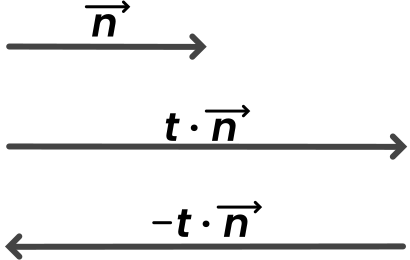
Multiplying a vector by a number changes the length, but not the direction, of the vector, unless you multiply by a negative number. In that case the vector will be rotated degrees. If you have a vector written as a letter with an arrow, it follows the regular rules of algebra, like this:
Rule
Multiplication of Numbers and Vectors
If you have a vector on vector form , you contract the number with the vector, just like you did when you multiplied a number with a letter in algebra:
If you have the vector on coordinate form, , you can just multiply the number by all the coordinates in the vector:
Example 1
Find .
Example 2
Find .
Example 3
-
is a vector with the same direction as , but it is twice as long. You write it as .
-
is a vector in the opposite direction of , and it’s also three times as long as . It is written as .
Example 4
Find .
