

Learning Tools

Curriculum
All math topics


Analyzing Exponential Functions
Now we’ll take a look at an example where we analyze an exponential function. The method is as follows:
Rule
Analyzing Exponential Functions
- 1.
- Find the zeros.
- 2.
- Find the stationary points.
- 3.
- Find the inflection points.
Example 1
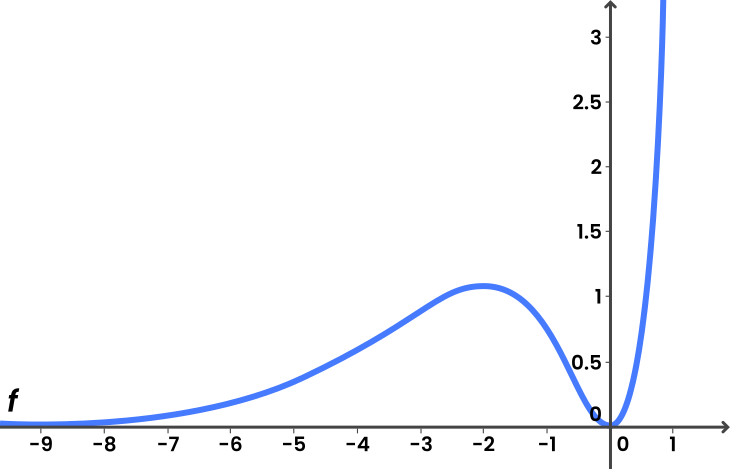
Analyze the function
- 1.
- Find the zeros by setting :
The zero product property gives that or . However, is always positive, so
This gives a zero at the origin .
- 2.
- Find the maxima and minima by setting .
First, find the derivative of :
Then, find where is equal to 0:
Again, is always positive, so
You then need the corresponding -values to find the point. You do this by inputting your -values back into the main function :
You now need to determine which point is a maximum and which is a minimum. You do that by drawing a sign chart.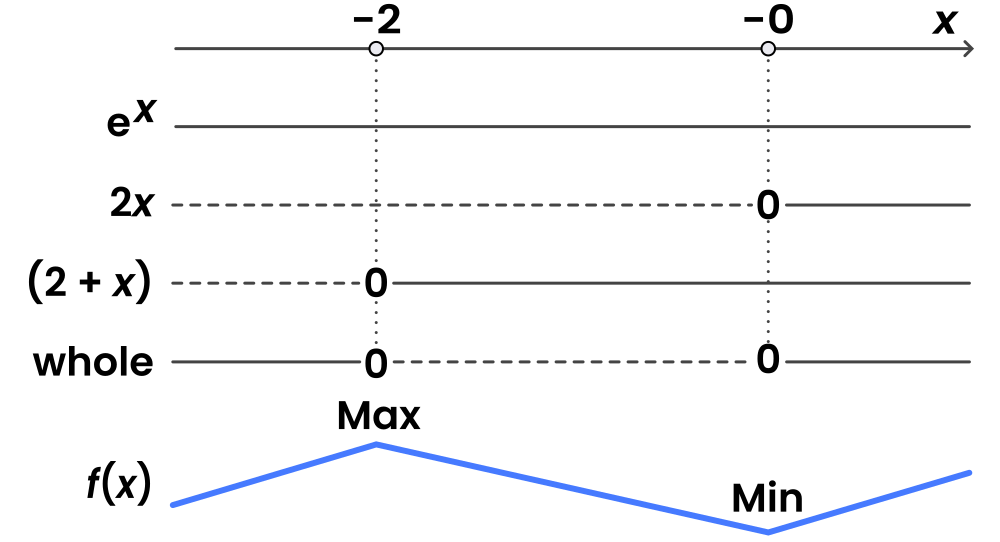 From this, you see that the maximum is and the minimum is .
 - 3.
- Find the inflection points by setting .
First, you find the second derivative by differentiating :
Then, let and solve the equation:As is always positive, you get
You solve this using the quadratic formula and get the solutions and . You find the corresponding -values by putting your new -values back into the main function . You then get:
which means that you have inflection points at and .
